
The demonstration is excellent. In minutes, an AI tool turns a folder of reports into a polished executive briefing. It summarises delays, proposes actions and answers follow-up questions fluently. The room can see what is technically possible.
But nobody has named the owner of the reporting workflow. There is no baseline for preparation time or correction rates. Some documents are confidential; nobody has confirmed where prompts, files or outputs go. The tool has not encountered a disputed figure or malicious instruction buried in a source file. “Human review” means an already busy manager will check it somehow. The cost case counts every gross minute saved and none of the verification, integration or monitoring work.
That is a demo, not an investable business case.
CEO’s Little Helpers takes a workflow-first position: begin with a named operating constraint, then earn the right to test and widen. The W.O.R.K.F.L.O.W. method below is an estate tool informed by external governance guidance; it is not an external standard, legal advice, cybersecurity assurance or certification.
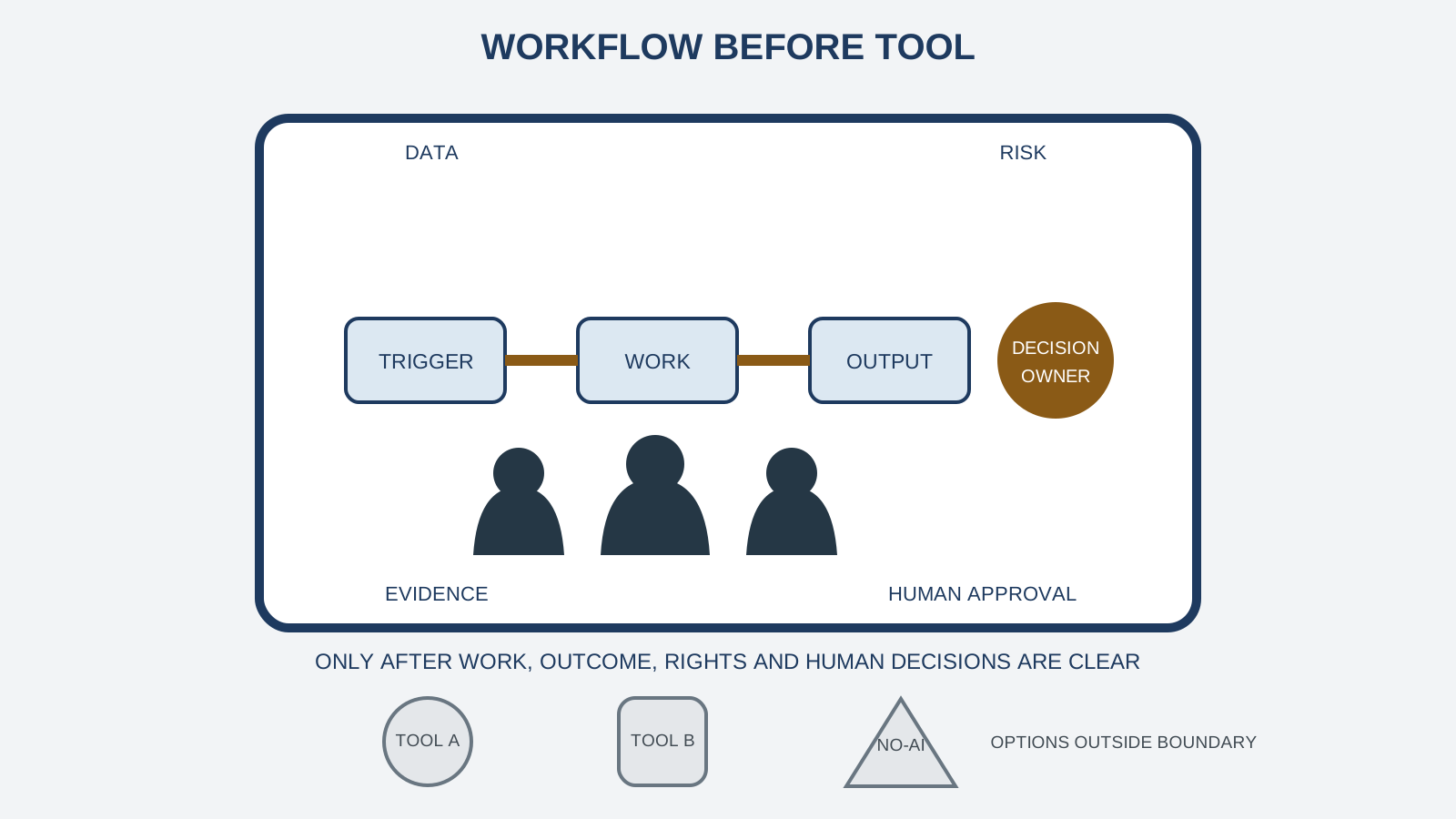
Workflow before tool
A workflow is the route from a trigger and authorised inputs, through activities, handoffs, decisions and exceptions, to an output. It has an accountable owner. A constraint materially limits its result: delay, rework, cost, quality, capacity or risk. An investigation candidate is a narrowly defined change worth examining—not “AI for finance.”
Other terms matter. A decision boundary states what a system may support and what remains human. A baseline describes current performance before the intervention. A comparator or counterfactual is the credible alternative against which the pilot is judged. A pilot is a bounded, reversible test. Shadow mode produces outputs without acting on them. Human oversight means a competent person has sufficient time, evidence and authority to detect, reject and escalate. Full cost includes implementation, review and exit, not merely licence price. Risk appetite is the organisation’s accepted level and type of exposure. A model change includes a new provider, model version, configuration or connected capability that could change behaviour or data flow.
No-AI options remain live: remove a step, repair the process, improve source data, strengthen search, apply rules or use conventional automation. Technology selection belongs after the workflow and evidence contract are clear enough to compare those alternatives.
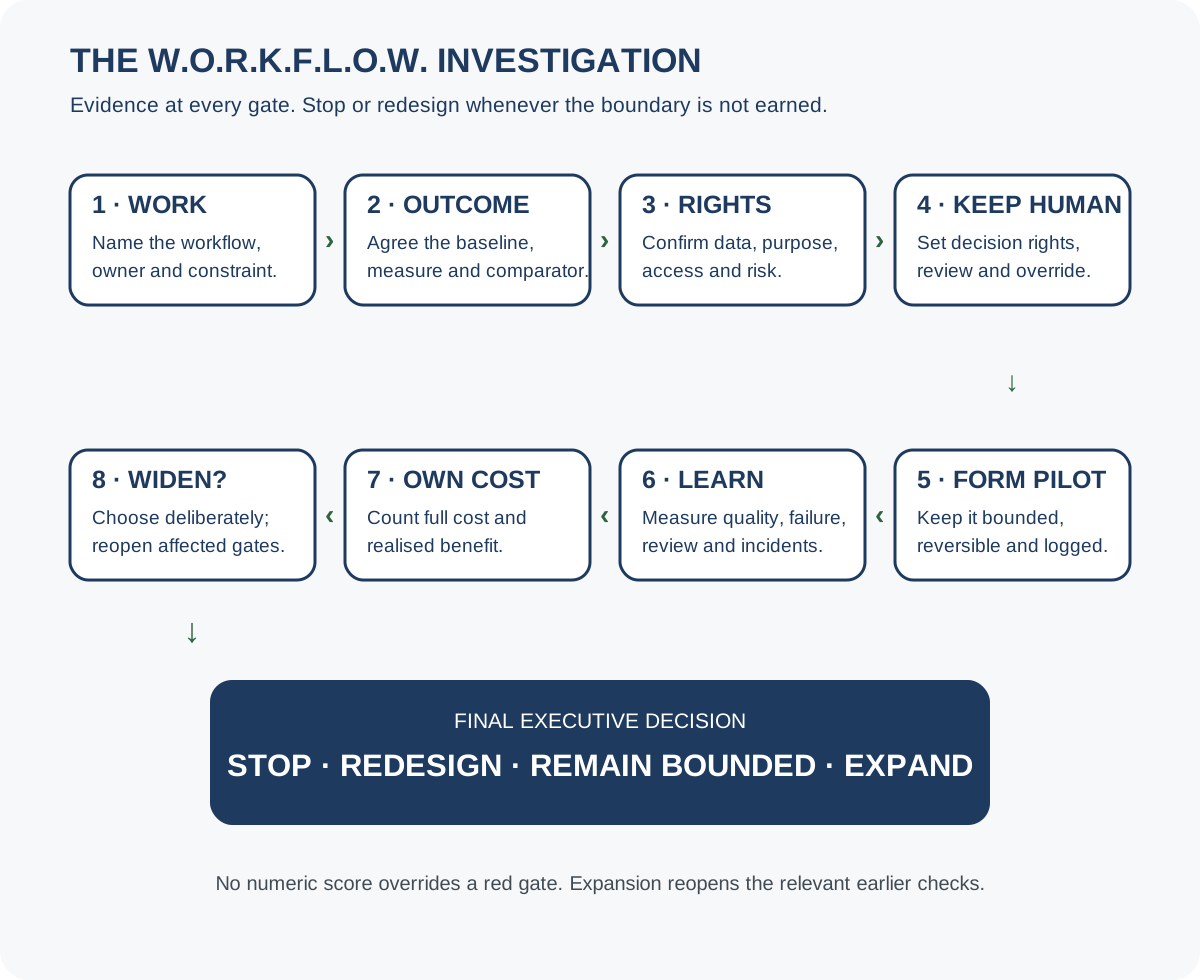
Accessible diagram equivalent: Work and constraint → Outcome and baseline → Rights, risk and data → Keep human decision rights. At each gate choose stop, redesign or continue. Only after Gate 4 should the team compare tools with no-AI alternatives. Then proceed to Form controlled pilot → Learn from performance and failure → Own economics → Widen deliberately or do not, again choosing stop, redesign or continue at every gate. The final decision is stop, redesign, remain bounded or expand; expansion reopens affected earlier gates.
The eight-gate W.O.R.K.F.L.O.W. investigation
1. W — Work and constraint defined
Map the trigger, input sources, activities, handoffs, decisions, exceptions, output and customer. Name the accountable owner and record the current delay, rework, cost or risk. Ask: What result is constrained? Where does evidence show the constraint occurs? Would removing a step, repairing data or using ordinary software address it more directly?
Required artefact — Current Workflow & Constraint Brief: trigger; sources; activities/handoffs; decisions/exceptions; output/customer; owner; observed burden; evidence records; no-AI alternatives.
Stop if: the problem is “we are not using AI,” no owner exists or process/data repair is the more direct next move.
2. O — Outcome and baseline agreed
Define success in terms of the real job, not AI output volume. Capture active human time and elapsed time; throughput and backlog; error, rework and exception rate; quality or customer measures; control measures; direct cost and consequence. State the sample period, exclusions and data quality. A Pilot Evidence Contract must later use the same definitions.
Required artefact — Baseline Sheet: measure; operational definition; source; current value/range; sample period; known gaps; owner. “Number of summaries generated” is activity, not business outcome.
Stop if: a credible baseline cannot be reconstructed and the test cannot safely create one before comparison. The OECD’s review of AI adoption in firms notes the difficulty of delimiting business cases and estimating ROI where counterfactuals are hard to establish; it does not provide a universal ROI formula.
3. R — Rights, risk and data boundary confirmed
List personal, confidential, privileged, commercially sensitive and copyrighted data. Confirm authority for the proposed purpose. Trace which provider and system receives prompts, files, metadata, logs, connector data, embeddings and outputs; whether data may be used for training; storage/processing region; retention and deletion; identities, roles and permissions; contracts and sector obligations. Ask what happens if an output is wrong, exposed or acted upon.
Treat untrusted source content as potentially hostile: direct or indirect prompt injection can place adversarial instructions in user input or retrieved content, a risk identified in the NIST Generative AI Profile. Avoid excessive agency, broad write access and unnecessary connectors. Apply least privilege and test revocation. The NCSC’s secure AI development guidance addresses secure design, deployment, logging and monitoring; although aimed mainly at providers, its lifecycle questions are useful to buyers and integrators. These sources support the named security principles, not the estate method or the safety of a particular system.
Required artefact — approved Data & Risk Boundary: allowed and prohibited data; purpose; systems/providers and flows; permissions; retention/deletion; reviewers; contracts; incidents; consequence and risk appetite.
Stop if: data is unauthorised, supplier terms or flows are unknown, permissions are excessive, integrations are unsafe or exposure exceeds appetite. The ICO AI and data-protection risk toolkit focuses on risks to individuals’ rights and freedoms; guidance and law can change, so check current ICO material and obtain appropriate advice.
4. K — Keep human decision rights explicit
Name the accountable workflow owner, support AI may provide, decisions prohibited in the pilot, the approval point before an output is sent, recorded or acted on, reviewer competence, exception owner, override and rollback. Consider affected people: can they understand, contest or appeal a consequential result? Could average performance hide a severe error or unfair effect on a subgroup?
Human oversight is not a rubber stamp. A reviewer needs time, authority, context, source access and a realistic ability to refuse. EU AI Act Article 14 expressly addresses awareness of possible over-reliance on system output—often called automation bias—for high-risk systems within scope. Training, interface and checks should therefore make disagreement and refusal practicable; this principle does not determine the legal classification of a particular workflow.
Required artefact — Decision-Rights/RACI Card: accountable owner; responsible operator; consulted specialists; informed stakeholders; permitted support; prohibited decisions; approval; exceptions; override; rollback.
Stop if: accountability is assigned to “the AI,” outputs cannot be meaningfully verified, reviewers lack competence or volume makes oversight nominal. For high-risk systems within its scope, EU AI Act Article 14 requires effective human oversight proportionate to risk. Do not assume every workflow is legally high-risk; determine scope with counsel.
5. F — Form the smallest controlled pilot
Choose narrow users and representative, approved data. Begin in shadow or draft-only mode. Compare the current process, a credible no-AI improvement and the AI-assisted route where feasible. Justify the test window and sample by the workflow’s frequency and variation; include difficult cases. State source and citation rules, logs, incident escalation, exit and rollback. No silent expansion of users, sources, actions or autonomy.
Required artefact — Pilot Evidence Contract:
Candidate and owner: __________
Users/data/systems in scope: __________
Explicit exclusions and prohibited actions: __________
Mode and comparator: __________
Window/sample and why it is adequate: __________
Measures and source-verification rules: __________
Logging, incident route and pause authority: __________
Continue criteria: __________
Stop/redesign criteria and rollback: __________
Stop if: production access is requested before boundaries, measures, incidents and rollback are ready.
6. L — Learn from performance, quality and failure
Version the provider, model and configuration. Measure task success, rubric-based quality, source accuracy, citation completeness, false positives/negatives where relevant, exceptions, reviewer corrections, incidents and near misses, affected-group effects, reliability, adoption and workarounds. Count displaced labour: prompt preparation, review, cleanup, integration support and exception handling. Test foreseeable misuse and retain severe examples; averages can conceal unacceptable failures.
Required artefact — Versioned Evaluation Report: baseline and comparator results; test set; quality and risk findings; errors; corrections; exceptions; incidents; user behaviour; displaced work; unresolved risks; configuration.
Pause or stop if: source fidelity is inadequate, severe errors are difficult to detect, exception load erases benefit or a material incident occurs. NIST’s AI Resource Center provides testing and evaluation resources, while the GAO accountability framework addresses governance, data, performance and monitoring. Neither endorses this estate method.
Summarise the evaluation in a Pilot Evidence Card. It prevents speed from hiding weak control or uneconomic review and gives the executive decision record four consistent evidence areas.
| Pilot Evidence Card quadrant | Record before the gate decision |
|---|---|
| Value | Cycle time, throughput and benefit genuinely realised or redeployed |
| Quality | Accuracy, source traceability, corrections and rework |
| Control | Access, human approval, exceptions, incidents and rollback readiness |
| Economics | Full cost, payback range, sensitivity and assumptions about scale |
Carry this card into Gate 8. A blank or materially weak quadrant is visible uncertainty, not a result to average away.
7. O — Own the economics
Separate operational effect, economic translation and risk/sustainability. Gross minutes saved are not cash. Time counts only when it is genuinely removed, redeployed to valuable capacity or changes cycle time, service or output.
Annualised realised benefit = hours genuinely removed or redeployed × defensible loaded cost/value + avoided external spend + measured incremental contribution − quality/rework losses − risk/incident allowance.
Total cost = licences/usage + integration and security + data preparation + training/change + human review + monitoring/maintenance + procurement/legal/vendor work + switching and exit provision.
Model conservative, base and upside cases; report a payback range and make assumptions visible. Do not annualise a short pilot without accounting for workload mix, adoption and scale cost.
Required artefact — Full-Cost Benefit Model: baseline, attributable change, redeployment rule, costs, risk allowance, sensitivity cases, payback range and owner.
Stop if: benefit disappears after review and full cost, depends on an exceptional operator or monetises time the business cannot use.
8. W — Widen deliberately—or do not
A successful bounded pilot does not automatically approve production. Decide among stop, redesign, remain bounded or expand. Specify the exact boundary being widened—users, data sensitivity, integrations, geography, action authority or autonomy—what new failure becomes possible and which earlier gates reopen. Provider, model, configuration or terms changes can also reopen evaluation and risk review.
Required artefact — Executive Decision Record: decision; evidence; dissent/uncertainty; owner; conditions; widened boundary; reopened gates; monitoring; rollback; next review date.
Stop if: ownership diffuses, monitoring will not operate at scale, risk exceeds appetite or expansion crosses an unassessed legal or security boundary. ISO/IEC 42001 describes an AI management-system and continual-improvement approach; use of this article is not ISO implementation or certification.
Score investigation suitability—not excitement
Score each dimension 0–3 to compare candidates and expose missing evidence. Lower consequence and integration dependence earn higher scores. There is no numeric approval threshold: one red gate overrides any total.
| Dimension | 0 | 1 | 2 | 3 |
|---|---|---|---|---|
| Constraint clarity | Vague AI ambition | Department pain | Named workflow problem | Measured bottleneck with owner |
| Frequency/volume | Rare/unknown | Occasional | Regular | Frequent enough to test promptly |
| Baseline availability | None | Anecdotal | Partial records | Reliable comparison baseline |
| Outcome measurability | Undefined | Proxy only | Usable rubric/KPI | Clear multidimensional measures |
| Reversibility | Hard to undo | Material switching cost | Bounded rollback | Shadow/draft mode; easy rollback |
| Human reviewability | Cannot be checked | Specialist/slow | Feasible | Sources/criteria make review routine |
| Data readiness | Unauthorised/unknown | Major gaps | Approved with limits | Approved, documented, fit for purpose |
| Consequence if wrong* | Severe/irreversible | Material | Moderate | Low/bounded |
| Integration dependence* | Broad production access | Several critical systems | Limited integration | Standalone/controlled sandbox |
| Economic hypothesis | None | “Save time” | Cost/benefit categories | Baseline, full-cost logic and decision rule |
\*Reverse-scored for suitability.
Red gates regardless of score are: prohibited or unlawful use; no accountable owner; unauthorised or confidential-data exposure; a material decision with no meaningful human verification or appeal; no rollback or incident route; output existence as the only success test; or unknown supplier terms/data flows. A high-value but unreviewable candidate may deserve process research, not an AI pilot. A mundane, frequent, low-consequence and reviewable task is often a stronger first investigation.
Worked example: a weekly executive briefing
“Use AI for executive reporting” is too broad. Reframe it: every Thursday, an operations lead spends an illustrative six hours assembling Monday’s briefing from three approved systems. Status summaries recur, late changes create rework and executives sometimes cannot trace a statement to its source. Exceptions require human judgement.
Build an eight-week baseline from calendars, document histories and correction logs: preparation and elapsed time, late inputs, unsupported statements, corrections, reference completeness and executive usefulness. Eight weeks and the figures here illustrate method, not a universal sample or expected result.
The approved boundary allows read-only extracts from the three named systems. It excludes personal performance commentary, privileged legal material, customer free text and any write-back. Privacy, security and procurement review provider data flows, training use, retention, region, access, deletion and model/configuration. The operations lead remains accountable. AI may produce a cited draft; it may not send, publish, alter a source system, resolve an exception or recommend action without labelled human analysis.
Run four shadow cycles against both the current process and a structured no-AI template. Include at least one difficult case with conflicting source values. Log tool/model/configuration, prompts, sources, unsupported claims, citation errors, reviewer corrections, preparation plus verification time, exceptions, incidents and workarounds.
Continue bounded only if the agreed quality and traceability measures hold, verification is practicable, no boundary or material incident occurs and conservative realised value exceeds full cost. Stop or redesign if severe errors are hard to detect, prompt injection or leakage defeats the boundary, review absorbs the saving, executives find the brief less useful or the ordinary template performs as well. Those criteria produce a decision even when the answer is “no AI.”
Read the result without fooling yourself
Use these decision cases:
| Evidence pattern | Executive response |
|---|---|
| Speed improves; quality worsens | Stop or redesign; speed does not compensate for an unacceptable outcome. |
| Review absorbs the saving | Fix reviewability or reject the economic claim. |
| Quality rises; cost rises | Decide whether measured quality is worth the full incremental cost. |
| Scale cost is uncertain | Remain bounded and test the scale assumption before integration. |
| Benefit depends on one exceptional operator | Test transferability; do not annualise their result. |
| Supplier terms, model or data flow changes | Pause and reopen rights, security, evaluation and economics gates. |
| Conventional automation performs as well | Prefer the simpler, more predictable option. |
Ten failure modes to catch early
| Failure mode | Operational test or consequence |
|---|---|
| Tool theatre | Is a product demonstration driving the project before anyone has named the constraint and owner? |
| Prototype fallacy | A plausible output is mistaken for a reliable workflow with controls, exceptions and maintenance. |
| Time-saving fiction | Gross minutes are priced as cash although no cost, capacity, cycle-time or output change is realised. |
| Hidden review factory | Measure preparation, checking, correction and escalation together; benefit may have moved into verification. |
| Data-boundary creep | Compare actual prompts, uploads, connectors and logs with the approved boundary; pause unexplained expansion. |
| Nominal human oversight | Can the reviewer detect an error, refuse the output and escalate before action—or are they merely present? |
| Integration before evidence | Production access creates switching cost and exposure before the bounded test earns either. |
| Averages hide severe failures | Inspect worst cases, affected groups and error detectability, not only mean quality or time. |
| No-AI alternative omitted | If process repair, rules or conventional automation is absent from the comparison, the pilot cannot establish AI’s added value. |
| Pilot purgatory | Without a decision owner, criteria and date, a temporary test becomes an unmanaged permanent service. |
Retain a versioned audit trail: workflow brief, baseline definitions and period, decision-rights record, approved data boundary, supplier terms, provider/model/configuration, test set, prompts or instructions where appropriate, incidents and exceptions, evaluation, full costs and gate decision. Monitoring must include drift, reliability, usage, workarounds, incidents, access and supplier/model changes. Exit means revoking access, disabling integrations, handling retained data and preserving necessary records—not simply cancelling a licence.
Privacy, employment, intellectual-property, sector and AI-law duties depend on jurisdiction, purpose, data and impact. High-impact or regulated uses require appropriate legal, privacy, security and domain expertise. This field guide cannot determine compliance or safety for a specific deployment.
The Monday-ready action is straightforward: name one workflow, complete Gates 1–4 and stop before selecting a tool if you cannot produce the four required artefacts. That discipline alone can prevent an attractive demonstration from becoming an unmanaged commitment.
For the wider executive context, read the CEO’s AI Leverage Blueprint. For leaders who already have a named constraint, the AI Operating Map is a later, separate and qualified engagement. Neither the paper nor this method promises ROI, compliance or a safe deployment without organisation-specific evidence and review.